
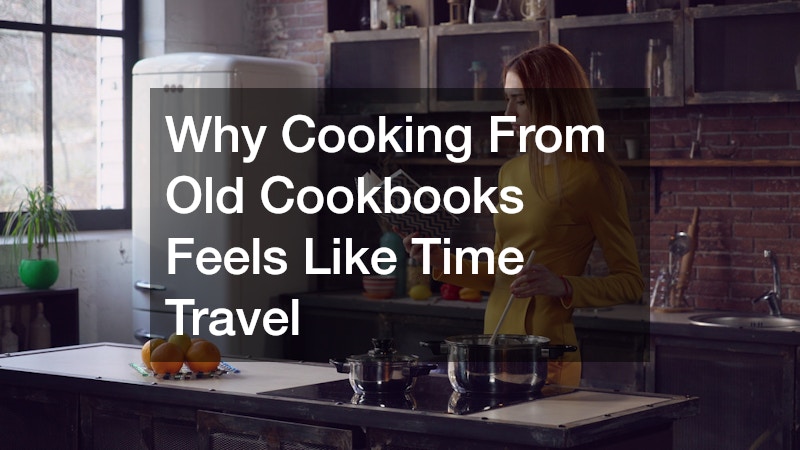

Pull a mid-century cookbook off a thrift store shelf — the kind with a cracked spine and someone else’s pencil marks in the margins — and something happens that a food blog never quite replicates. The instructions assume you already know things. The ingredient lists reference brands that no longer exist. The serving sizes imply a table crowded with people. Before you’ve cooked a single dish, you’re reading a document written by and for a world that has genuinely passed, and that gap between then and now is where the time travel begins.
What the Language of Old Recipes Actually Tells You
Recipe writing has always encoded the assumptions of its era, and those assumptions are visible the moment you start reading. A 1950s casserole recipe that calls for “a can of soup” doesn’t specify brand or size because there was effectively one option. A 1970s dinner party dish might instruct you to “serve on a bed of iceberg” without bothering to call it a salad, because no other lettuce was meaningfully available to most American home cooks at that time.
This is where old cookbooks function less like instruction manuals and more like cultural documents. The vagueness isn’t sloppiness — it’s the author writing to a reader they assumed shared an entire world of context. When that shared world disappears, the gaps become legible.
Reading across three or four decades of cookbooks, a few shifts become obvious. Instructions grow longer and more explicit as the assumed base of household cooking knowledge shrinks. Portion sizes shift noticeably, reflecting both changing economics and changing ideas about abundance. The prominence of gelatin in savory dishes — a whole era of molded salads and suspended vegetables — rises and falls in ways that track both refrigeration technology and fashion simultaneously.
For the curious cook, this makes old cookbooks worth reading even when the recipes aren’t worth making. They answer questions about daily life that history books rarely address: what a family in a particular decade considered a special occasion meal, how much time was assumed to be available on a Tuesday night, and what convenience meant before that word had its current meaning.
The Ingredient Problem — and Why It’s More Interesting Than Frustrating
The most immediate practical challenge with old recipes is ingredients that have changed, disappeared, or split into multiple modern descendants. Shortening behaves differently than it did in the 1940s, when formulas were less standardized. “Bread flour” in a 1960s recipe might have had a different protein content than what carries that label today. Certain fats that were standard pantry items have nearly vanished from mainstream grocery stores.
There’s a real decision to make here. One approach is direct substitution: swap modern equivalents as close as possible and cook the recipe as written. This tends to work well for baked goods where structure matters less than flavor. The alternative is research-first cooking — spending time understanding what the original ingredient actually did before deciding how to replicate it. This takes longer but produces results closer to what the author intended, and it teaches more.
For everyday old recipes, direct substitution is usually fine and often produces excellent results. Where it breaks down is in older baking recipes with very precise ratios, or in dishes where a now-obscure ingredient was doing genuine chemical work — acting as a leavening agent, a thickener, or an emulsifier — rather than just adding flavor. A 1930s cake that calls for a specific type of baking powder is worth researching before assuming modern double-acting powder is a clean swap.
The ingredient hunt itself can become part of the experience. Specialty grocers, ethnic food markets, and mail-order suppliers stock things that most supermarkets dropped decades ago. Some ingredients that felt genuinely lost — certain dried chiles, specific grain varieties, regional curing salts — are quietly back in circulation because of renewed interest in traditional food ways.
Reading the Margins, the Stains, and the Crossed-Out Lines
A used cookbook carries two texts: the one that was printed and the one added by whoever owned it first. Both are worth reading carefully.
Penciled notes in the margins are a form of field testing data. “Too sweet — cut sugar by half” is more useful than any published review. “Double the garlic” suggests the original quantity was timid. A recipe with no annotations at all, in a book clearly used and worn, might mean it was perfect as written — or that it was tried once and abandoned. Context clues help: if the surrounding pages show heavy use and this one is pristine, that’s information.
Stains and splatter tell you which recipes were actually cooked versus which were aspirational. A chapter on elaborate party food with clean pages alongside a batter-speckled weeknight section is a domestic history in shorthand.
Crossed-out ingredients deserve particular attention. When someone physically struck a line through an ingredient and wrote something else, they were solving a problem — usually an availability problem, a taste preference, or a dietary change. Those substitutions are often the most directly practical notes in the whole book, because they represent a real person working through exactly the kind of adaptation a modern cook faces.
Recipes passed down through families sometimes carry three or four generations of these amendments, making them genuinely collaborative documents — closer to living recipes than fixed ones. If you find a book like this in a secondhand store, it’s worth more than the $3 on the sticker.
When to Cook the Recipe Straight and When to Adapt
Not every old recipe deserves faithful reconstruction. Some dishes were products of postwar convenience culture — assembly instructions for canned and processed ingredients — that don’t improve with modern substitutes because the original was never really about flavor to begin with. Others represent genuine technique built on time-tested ratios, and those reward the effort of cooking straight.
A useful threshold: if the recipe’s appeal is primarily nostalgic, cook it as close to the original as possible, including the chocolates era pantry items if you can find them, because the point is the experience. If the appeal is flavor, adapt freely and treat the old version as a starting point rather than a target.
The broader decision — time-intensive faithful recreation versus practical modern adaptation — comes down to what you’re actually trying to get from the process. Faithful recreation teaches technique and history. Practical adaptation teaches what works in your kitchen with what you have. Both are legitimate, and neither is more “correct” as a mode of engaging with old recipes.
What old cookbooks resist is indifference. You can’t cook from them on autopilot the way you might follow a tested, headnoted contemporary recipe. They require active reading, some deduction, and a tolerance for ambiguity. That friction is part of what makes them feel different — and why pulling one off a shelf still produces, reliably, a sensation that ordinary recipe browsing does not.
Starting Your Own Exploration Without Collecting Endlessly
Cooking from old cookbooks doesn’t require owning hundreds of them. A focused collection of ten to fifteen books spanning specific decades or regional traditions teaches far more than a wall of volumes that never get used.
- Start with one era rather than all eras at once — choosing cookbooks published within a single 20-year window lets you notice patterns and assumptions specific to that period rather than having them blur together.
- Before cooking any recipe more than 80 years old, spend 15 minutes identifying every ingredient that may have changed in formulation or availability, then decide on substitutions before you start rather than improvising mid-process.
- Prioritize books with handwritten annotations when buying secondhand — a previously owned and used cookbook with margin notes is almost always more useful than a pristine copy of the same edition.
Thrift stores, estate sales, and library sales are the most reliable sources, typically priced between $1 and $5 per book. First-edition collectible cookbooks have a separate market entirely and aren’t necessary for cooking purposes. The goal is a working library, not an archive — books that you’ll actually open, splatter, and annotate in turn.