

You’ve scrubbed the counters, vacuumed the floors, wiped the baseboards — and the room still feels wrong. Not dirty, exactly. Just unsettled. That specific unease doesn’t usually point to what was missed during cleaning. It points to something the cleaning process doesn’t touch: accumulated odor trapped in materials, lighting that flattens a space, acoustic dead spots, or ventilation patterns that move stale air around rather than removing it. These are problems with the room itself, not your cleaning routine, and they require a different kind of diagnosis.
When the Problem Is the Air, Not the Surfaces
Cleaning removes visible grime, but indoor air quality operates on a separate cycle. Upholstered furniture, carpet padding, drywall, and wood cabinetry all absorb airborne compounds over time — cooking byproducts, VOCs from paint and adhesives, humidity, and biological material from pets or plants. A freshly cleaned room can smell fine for an hour and then return to its baseline odor as these materials off-gas back into the air.
The key distinction worth understanding here is between cleaning for appearance and cleaning for air chemistry. Surface wiping addresses neither embedded odors nor circulation problems. A room that was painted two years ago with standard interior latex paint continues releasing low-level VOCs for months — a fact that catches most people off guard when they assume a repainted room should smell neutral.
Ventilation matters more than most people account for. Rooms with single-direction airflow — where a window or vent introduces air but there’s no exit path — don’t ventilate effectively. Opening two windows on opposite sides of a room, even slightly, creates cross-ventilation that a single open window cannot replicate. If the room has no operable windows, a HEPA air purifier with an activated carbon stage is more effective than a standard filter, since carbon specifically binds odor-causing compounds rather than just capturing particulates.
- Run an activated carbon air purifier for at least 4 hours after cleaning a room, not during, to avoid recirculating disturbed particles back into the air.
- Replace HVAC filters every 60 to 90 days in rooms with pets or high cooking activity — standard 1-inch filters are rated for 30 days under those conditions, not 90.
- Wash upholstered slipcovers and throw pillows at 140°F when possible, as lower temperatures don’t fully neutralize odor-causing bacteria in fabric.
Lighting Conditions That Make Clean Rooms Feel Unclean
This one surprises people. Lighting affects perceived cleanliness in ways that are easy to underestimate. Cool-toned light (above 5000K) tends to emphasize contrast, which means minor dust, grease residue, or surface scuffs that a warmer bulb would visually absorb instead get thrown into sharp relief. Conversely, a room that’s too dim obscures shadows in corners and on baseboards in a way that reads subconsciously as unclear or grimy, even when those surfaces are spotless.
The other common factor is directionality. A single overhead fixture, especially a flush-mount, creates flat, even light across the room. Flat light eliminates shadows but also flattens dimension — the room loses the texture and depth that make a space feel inhabited and finished rather than institutional. Adding a lamp at a lower angle, or using sconces that direct light at a wall to create indirect fill, changes the room’s character substantially without a single cleaning task.
Color rendering index (CRI) matters too. Bulbs with a CRI below 80 make colors look muted and surfaces look ambiguous — neither visually clean nor dirty, just undecided. Bulbs rated CRI 90 or above render fabric, wood grain, and painted surfaces the way natural daylight does, which actually helps a room look cleaner because contrast between clean and grimy surfaces reads clearly rather than blending together.
- Replace any bulb below 2700K in a living or sleeping space if the goal is warmth — save 4000K and above for task areas like kitchens and home offices.
- Test the effect of adding one tabletop lamp at furniture height before investing in new overhead fixtures, since repositioning light sources costs nothing.
- If a room has no dimmer, a smart bulb with tunable color temperature lets you shift from task lighting to ambient lighting without rewiring anything.
Acoustics, Clutter Patterns, and the Feel of a Room That Doesn’t Sit Right
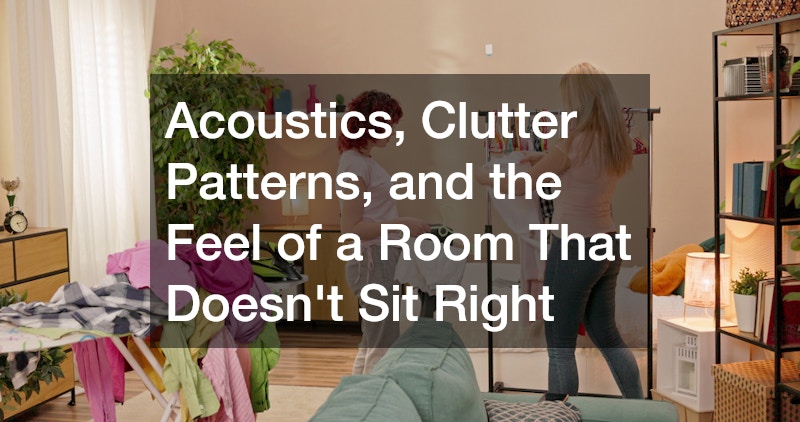
Sound behavior is one of the most overlooked reasons a room feels uncomfortable even after everything visible has been addressed. Hard, empty surfaces — bare floors, uncurtained windows, sparse furniture — create a slightly reverberant space where ambient sound bounces instead of being absorbed. The effect is subtle but registered. Rooms with too much acoustic reflection tend to feel restless or cold, even when they’re spotless and well-lit.
The fix isn’t necessarily more furniture. A large area rug covering at least two-thirds of the floor’s open surface absorbs a meaningful amount of reflected sound. Heavy curtains do the same for the window wall. The reason this matters beyond comfort is that acoustic harshness is one of the reasons people feel like something is “off” and attribute it to cleanliness or clutter when the actual variable is sound energy.
Clutter patterns create a related but different effect. A room with too few items often feels just as wrong as one with too many — the visual field has no resting points, which creates ambient restlessness. When people declutter aggressively, they sometimes strip a room down past the point where it reads as habitable. Removing every surface object from a shelf or sideboard doesn’t clean a room so much as hollow it out. Two or three deliberate objects hold the eye better than nothing at all.
This logic applies even in transitional spaces. A garage with loft, for instance, often gets furnished sparsely since it occupies an in-between role, but the same acoustic and visual anchoring principles apply — a bare concrete floor and empty walls will feel off regardless of how recently the space was swept.
Structural and Moisture Issues Disguised as Cleaning Problems
Some rooms that feel consistently wrong are pushing back against something at the building level. A faint musty quality that returns within a day or two of deep cleaning usually points to moisture in the subfloor, wall cavity, or around a window frame — not to something missed during the clean. Similarly, rooms with persistent cold spots, drafts at floor level, or walls that feel slightly tacky in humid weather are signaling insulation or vapor barrier issues that a cleaning routine cannot address.
The distinction between a cleaning problem and a structural problem is worth being direct about because the response is so different. Cleaning problems respond to effort and consistency. Structural problems don’t — they degrade gradually while appearing to respond intermittently to surface cleaning, then return.
Signs to look for:
- Painted drywall that feels chalky or slightly rough compared to adjacent walls may indicate moisture cycling through the surface, not just age.
- A room that smells noticeably different after rain points to inadequate flashing or sealant at window frames or roof lines, not interior air quality.
- Grout that darkens again within two weeks of being scrubbed usually indicates water wicking through tile from behind, which is a substrate problem, not a cleaning frequency problem.
If any of these apply, a moisture meter (available for under $30 at most hardware stores) can identify whether a wall or floor surface has elevated moisture content before committing to more invasive investigation.
Knowing When the Room Needs Work, Not a Deeper Clean
The pattern in all of the above is the same: the room continues to feel wrong because the source of the problem exists outside the scope of cleaning. That’s not a failure of effort — it’s a diagnostic mismatch. Once the actual variable is identified, whether that’s air chemistry, lighting quality, acoustic behavior, or a moisture issue at the building level, the corrective action becomes much clearer and usually far less labor-intensive than another round of intensive cleaning. The useful question to ask isn’t “what did I miss?” but “what is this room actually telling me?”