


Leadership rarely announces itself through job titles or formal training programs. The qualities that make someone genuinely worth following — composure under pressure, the ability to read a room, consistency when motivation fades — tend to develop outside the office, in the small disciplines people build around the edges of their working lives. What someone does with their evenings and weekends turns out to matter more to their professional trajectory than most career advice acknowledges.
Why Consistency Outside Work Signals Capacity Inside It
There’s a structural reason why extracurricular habits reveal leadership potential: they’re voluntary. No performance review compels someone to show up to a 6 a.m. rowing session or finish a difficult book they started three months ago. That self-imposed accountability — sustained without external reward — mirrors exactly what organizations need from people in charge of teams, budgets, and decisions.
Research from organizational psychology consistently links self-regulation outside work to higher performance in roles requiring sustained attention and emotional control. The mechanism isn’t mysterious. Someone who has built a long-running habit, whether it’s distance running, a weekly chess club, or a community orchestra, has already solved the problem most aspiring leaders struggle with: maintaining effort when results are delayed.
The practical implication here involves choosing habits that have a feedback loop. Running five miles without tracking pace teaches endurance; tracking pace over six months teaches how effort compounds. The difference between a hobby and a leadership incubator often comes down to whether someone is measuring anything.
- Log at least one measurable output from any chosen habit — pace, words written, weight lifted — and review it monthly to observe how incremental effort produces nonlinear improvement over 90-day periods.
- Choose at least one activity with a social accountability structure (a team, a club, a cohort) rather than a purely solitary pursuit, since peer accountability develops the negotiation instincts that formal leadership demands.
- Spend no more than 20% of extracurricular time on passive consumption (podcasts, reading without notes) and at least 80% on active production or physical execution.
Physical Disciplines That Restructure How You Handle Pressure

Combat and contact sports have a disproportionate presence in leadership biographies, and the connection is worth examining directly rather than treating it as coincidence. Disciplines that put someone under controlled physical stress — and require composure during that stress — produce a measurable shift in how the nervous system responds to non-physical pressure. A difficult board presentation or a personnel conflict triggers similar threat responses to physical confrontation; people who’ve trained to stay technical under duress carry that conditioning into the conference room.
Martial arts classes, for instance, develop specific attributes rarely cultivated in professional settings: the capacity to absorb failure repeatedly without catastrophizing, the habit of reading an opponent’s body language in real time, and the discipline of executing memorized technique when instinct screams to improvise. These translate directly into the leadership behaviors executives are coached to develop — often at significant consulting expense.
The choice between competitive and non-competitive physical disciplines matters here. Competitive formats (team sports, tournament-based martial arts, obstacle racing with a clock) accelerate comfort with public evaluation and losing. Non-competitive formats (yoga, endurance running, strength training) deepen internal regulation and patience. Leaders who combine both over time develop a fuller emotional range than those who train exclusively in one mode. A useful threshold: if a physical habit has never put someone in a position where they might visibly fail in front of others, it’s only doing half the work.
Creative and Intellectual Habits That Develop Strategic Thinking
The cognitive demands of sustained creative work — writing, musical practice, drawing from observation — overlap more with strategic leadership than most people expect. Both require holding competing constraints in mind simultaneously, making decisions with incomplete information, and tolerating a gap between current performance and eventual standard.
Musicians who practice seriously understand this instinctively. A pianist working through a difficult passage can’t simply try harder; they have to diagnose which specific finger transitions are failing and design isolated practice for those moments alone. That diagnostic rigor — breaking a complex failure into addressable components — is identical to how effective leaders troubleshoot underperforming teams or stalled projects.
Writing produces a different but equally valuable effect. Someone who writes regularly (a private journal, long-form commentary, even detailed project retrospectives) develops the habit of converting fuzzy impressions into precise language. That skill sits at the center of almost every leadership failure: the inability to articulate direction clearly enough for others to act on it. A useful practice is committing to 250 words of structured reflection after any significant professional event — a difficult meeting, a project completion, a hiring decision — rather than treating the experience as background noise.
- Read one book per month outside your direct professional field, then write a 300-word summary of what the central argument implies for your current role — the translation exercise matters more than the reading itself.
- Spend at least 30 minutes weekly on a creative skill that requires physical precision (sketching, instrument practice, model building) to train fine-grained attention and tolerance for imperfect output.
- Maintain a decision log — record three decisions per week, including the reasoning and expected outcome, then review them quarterly to identify patterns in how you weigh risk versus reward.
Community Involvement and the Hidden Leadership Laboratory
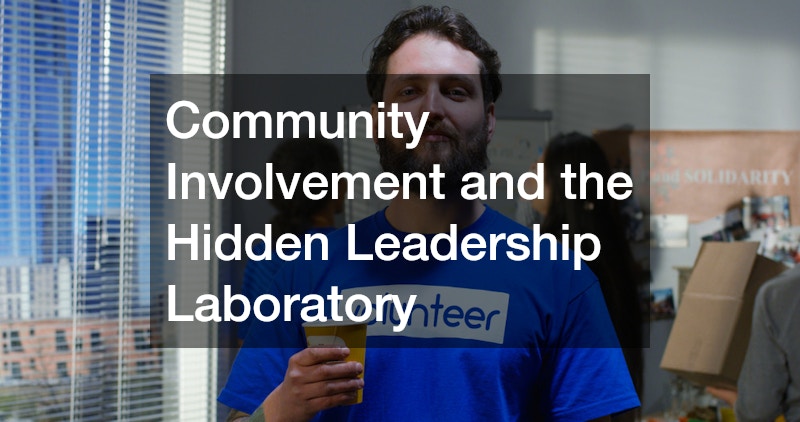
Volunteering, coaching youth sports, organizing neighborhood events — these are the activities professionals most often deprioritize when calendars tighten, and that deprioritization carries a cost that rarely shows up until someone is promoted into a role requiring genuine influence without formal authority.
Volunteer and community settings are unforgiving in one specific way: people participate because they want to, not because they’re compensated. Motivating volunteers, navigating disagreements between people who owe you nothing, building consensus around shared goals without a hierarchy to enforce decisions — these are harder leadership tasks than most corporate environments present. Someone who has successfully organized a group of thirty volunteers for a recurring community initiative has navigated organizational complexity that many mid-level managers never encounter.
The comparison worth making is between leading through authority and leading through persuasion. Corporate environments typically train the former; community involvement forces the latter. Leaders who have only operated through positional authority tend to struggle significantly when they encounter high-performing employees who don’t respond to hierarchical pressure, or when they move into roles requiring cross-functional influence.
- Commit to at least one leadership role in a volunteer context — committee chair, team coach, event organizer — rather than a participant role, since active leadership responsibility is what develops the relevant skills.
- Seek out community contexts with demographic diversity from your professional network; the communication adjustment required accelerates adaptability faster than homogeneous environments.
- Run at least one complete project cycle — planning, execution, debrief — within a volunteer context annually, treating the debrief as seriously as a paid professional retrospective.
Starting Where You Actually Have Time
The practical obstacle most professionals cite is not motivation but margin. Extracurricular leadership development works only if the habits stick, which means starting with frequency rather than duration. A 20-minute writing session three mornings a week builds more cognitive discipline over six months than an intensive weekend workshop repeated twice a year. Compounding is the mechanism; it requires repetition, not heroics. Audit the current week honestly — not the ideal week — and identify two recurring time slots of at least 15 minutes that are consistently unscheduled. Those two windows are where a new habit can actually live. Add a third only when the first two have held for eight consecutive weeks without rescheduling.