
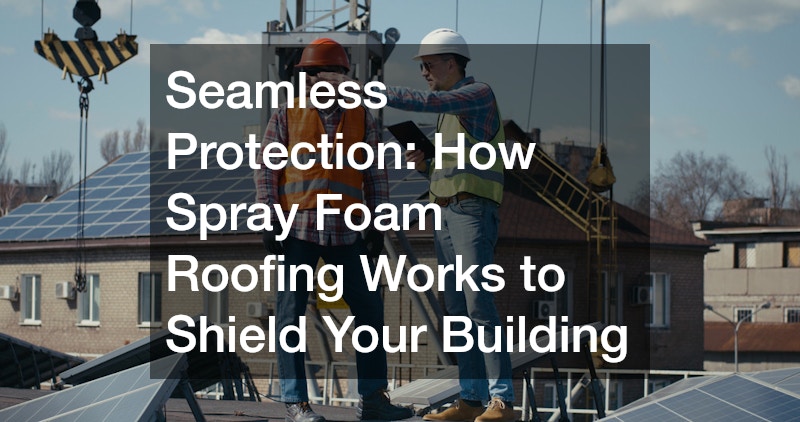

Maintaining a durable, leak-free roof is one of the most critical challenges facing commercial building owners and facility managers. Traditional flat and low-slope roofing materials such as modified bitumen, TPO, and built-up roofing rely on sheets or membranes joined together with seams. Over time, heat, rain, and thermal expansion weaken these seams, creating entry points for water. Spray polyurethane foam offers an alternative approach by creating a single, continuous barrier across the entire roof deck. Understanding how this technology works clarifies why it provides long-lasting protection against leaks and energy loss.
The Chemical Reaction Behind the Barrier
At its core, spray polyurethane foam is created on-site through a controlled chemical reaction. Two liquid components, a polyol resin and an isocyanate, are stored in separate tanks on an application rig. These liquids are pumped through heated hoses to a specialized spray gun, where they mix under high pressure right as they exit the nozzle.
When sprayed onto a prepared roof deck, the liquid mixture reacts instantly, expanding significantly within seconds. As it expands, the liquid transforms into a dense, rigid foam layer that conforms to every contour of the roof surface. This rapid expansion fills cracks, gaps, flashings, and penetrations, creating a uniform layer over the roof.
Because the liquid fills every crevice before expanding, it adheres directly to substrate materials like plywood, concrete, metal, or existing single-ply membranes. This direct bond eliminates voids where moisture can become trapped beneath the surface.
Monolithic and Seam-Free Waterproofing
The primary advantage of spray foam roofing is its monolithic structure. Traditional roof systems require overlapping seams, fasteners, and flashings around HVAC units, pipes, and drains. Every seam and penetration represents a potential point of failure.
Spray foam creates a seamless, self-flashing layer with zero mechanical fasteners penetrating the surface. The foam expands directly around pipes, parapet walls, skylights, and HVAC curbs, sealing complex geometries without requiring custom rubber boots or metal collars.
Additionally, the rigid foam used in exterior applications features a closed-cell structure. Closed-cell foam consists of microscopic, sealed air pockets. Unlike open-cell foam used indoors for soundproofing or attic insulation, closed-cell foam is hydrophobic and highly water-resistant. Even if the top protective coating suffers physical damage from hail or flying debris, water cannot travel laterally through closed-cell foam or penetrate the building interior.
Exceptional Thermal Resistance and Energy Savings
Waterproofing is only half the protection equation; thermal management is equally vital. Spray foam roofing delivers high thermal resistance compared to traditional commercial roofing materials.
Conventional roof insulation boards are laid down in sheets with gaps between them. These gaps allow heat to transfer via thermal bridging. Spray foam eliminates thermal bridging by providing a solid, uninterrupted insulating blanket over the entire building envelope.
This high thermal resistance reduces heat transfer into the building during hot summer months and keeps warmth inside during winter. By stabilizing interior temperatures, the system eases the workload on commercial HVAC equipment, leading to lower utility bills and extending the operational lifespan of heating and cooling units.
Protective Elastomeric Topcoats
While closed-cell foam provides structural strength and insulation, it is vulnerable to degradation from ultraviolet (UV) radiation emitted by the sun. Left exposed, UV rays gradually break down the top layer of foam, causing it to turn chalky and erode over time.
To shield the foam from UV rays and weathering, technicians apply an elastomeric topcoat over the cured foam layer. Common coating materials include silicone, acrylic, or polyurethane coatings. Silicone coatings are particularly popular for flat roofs because they resist ponding water and reflect solar radiation.
Granules are typically embedded into the wet topcoat during application. These granules add impact resistance against hail and foot traffic while providing a textured, slip-resistant surface for maintenance workers. Together, the foam and protective coating form a dual-layer system engineered for long-term weather resistance.
Sustainable and Renewable Performance
Unlike traditional roofing systems that require complete tear-offs and disposal in landfills, spray foam roofing is a renewable asset. With proper maintenance and periodic inspections, a foam roof can last indefinitely.
As the protective elastomeric topcoat naturally wears down due to weather exposure, the roof simply needs to be power-washed and recoated. Applying a fresh layer of topcoat restores the UV barrier and extends the roof warranty without requiring structural repairs or adding heavy waste to local landfills.
Modern Structural Protection
Investing in a high-performance roof is essential for protecting structural assets, equipment, and occupants. By combining a seamless closed-cell insulation barrier with reflective elastomeric topcoats, spray polyurethane foam addresses both moisture intrusion and energy waste in a single application. For building owners seeking to eliminate recurring seam leaks, lower utility bills, and avoid expensive tear-offs, spray foam delivers reliable, long-term protection from the elements.